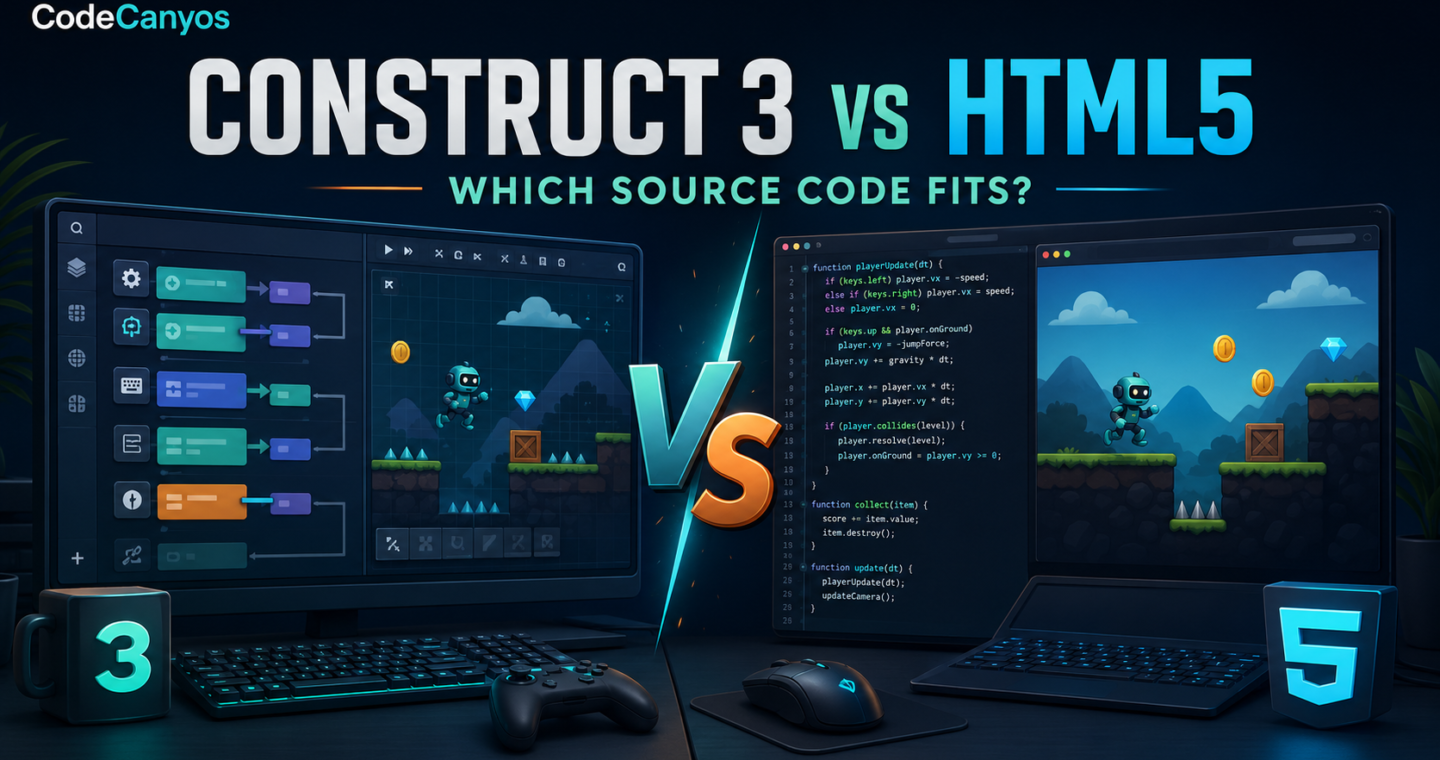
Construct 3 vs HTML5 JavaScript is not simply a comparison between easy and advanced development. Both can produce polished browser games, and both ultimately deliver HTML5 technology to players. The important difference is how the project is authored, customized and maintained.
Choose the workflow that matches your team, roadmap and release targets. Compare examples in the Construct 3 games category and the broader HTML5 game source code collection as you work through this guide.
What is a Construct 3 project?
Construct 3 is a visual game-development environment. Gameplay is commonly assembled with layouts, object behaviors and event sheets. It can export a web build and, depending on the project and services used, may also support packaged mobile or desktop releases.
The editable project is important. A web export from Construct 3 is not the same as the original project file. Before buying, verify that the download contains the source project and opens in a currently supported editor version.
What is code-first HTML5 JavaScript source code?
A code-first game exposes its JavaScript or TypeScript logic directly. It may use a framework such as Phaser or PixiJS, a custom canvas engine or standard browser APIs. Developers work with files, packages, version control and a build system instead of relying mainly on visual event sheets.
Some HTML5 downloads are minified production builds. Confirm that the package includes readable source, configuration and build instructions.
Learning curve and speed
Construct 3 often lets designers and beginners understand project flow quickly. Visual events make common movement, collision, scoring and scene changes easier to trace. This is valuable for prototypes, classroom projects and small teams that need frequent content changes.
JavaScript has a steeper initial learning curve, but it gives experienced developers direct control over architecture, testing and integrations. Standard coding skills transfer to web applications beyond games.
Customization depth
Both approaches support new levels, art, audio and mechanics. Construct is efficient when the desired changes fit its event system and available plug-ins. Code-first projects are often easier to extend when requirements include custom networking, unusual rendering, complex data flows or integration with an existing web platform.
The original project quality still matters more than the label. A clean Construct event sheet can be easier to maintain than disorganized JavaScript, and well-structured JavaScript can be clearer than a huge event sheet.
Performance and file size
Measure the actual build. Engine overhead, asset size, object count, effects and developer choices influence performance. Test first interaction time, memory, frame rate and device temperature on representative mobile hardware.
Construct can produce efficient casual games when layouts and events are designed carefully. Code-first development can remove unused systems and tune loading more deeply, but it does not guarantee performance automatically.
Team workflow and version control
Ask who will maintain the game in six months. A visual workflow helps when content editors are not programmers. A text-based codebase usually integrates more naturally with Git reviews, automated testing and larger engineering teams.
Establish file naming, backup and release procedures either way. Never edit the only copy of a project, and record the editor, framework and package versions used for each release.
Licensing and tool costs
Check the source-code license, third-party assets and the authoring tool separately. Construct projects may require an active plan for certain workflows or export capabilities. JavaScript frameworks are often open source, but plug-ins, fonts, art and hosted services can have their own terms.
Budget for the tools needed to open and export the project, not only the download price.
Deployment and hosting
Both options can produce static files suitable for web hosting. Test asset paths, caching, compression, security headers and browser compatibility. A game that works from a local folder may still need a web server because of browser security rules.
If you plan to embed the build in WordPress, a learning platform or a portal, test keyboard focus, responsive sizing and interaction with the surrounding page.
When Construct 3 is a strong choice
- A designer-led team needs rapid visual iteration.
- The game is a focused casual, puzzle or educational experience.
- New levels and rules fit a visual event workflow.
- The project has clear editable files and documentation.
When code-first HTML5 is a strong choice
- The team already works comfortably with JavaScript or TypeScript.
- The game must integrate deeply with a website or custom backend.
- Automated tests, code review and long-term engineering control matter.
- The roadmap includes systems outside the visual editor’s normal workflow.
A decision checklist
Score each candidate for editable source, documentation, team skills, tool cost, performance, integration needs and maintenance. Then build one representative change: add a level, replace art and connect a simple analytics event. The time required tells you more than a feature list.
Read the complete HTML5 game source-code guide for buyer checks that apply to both approaches. The better choice is the project your team can legally open, understand, modify, test and support.