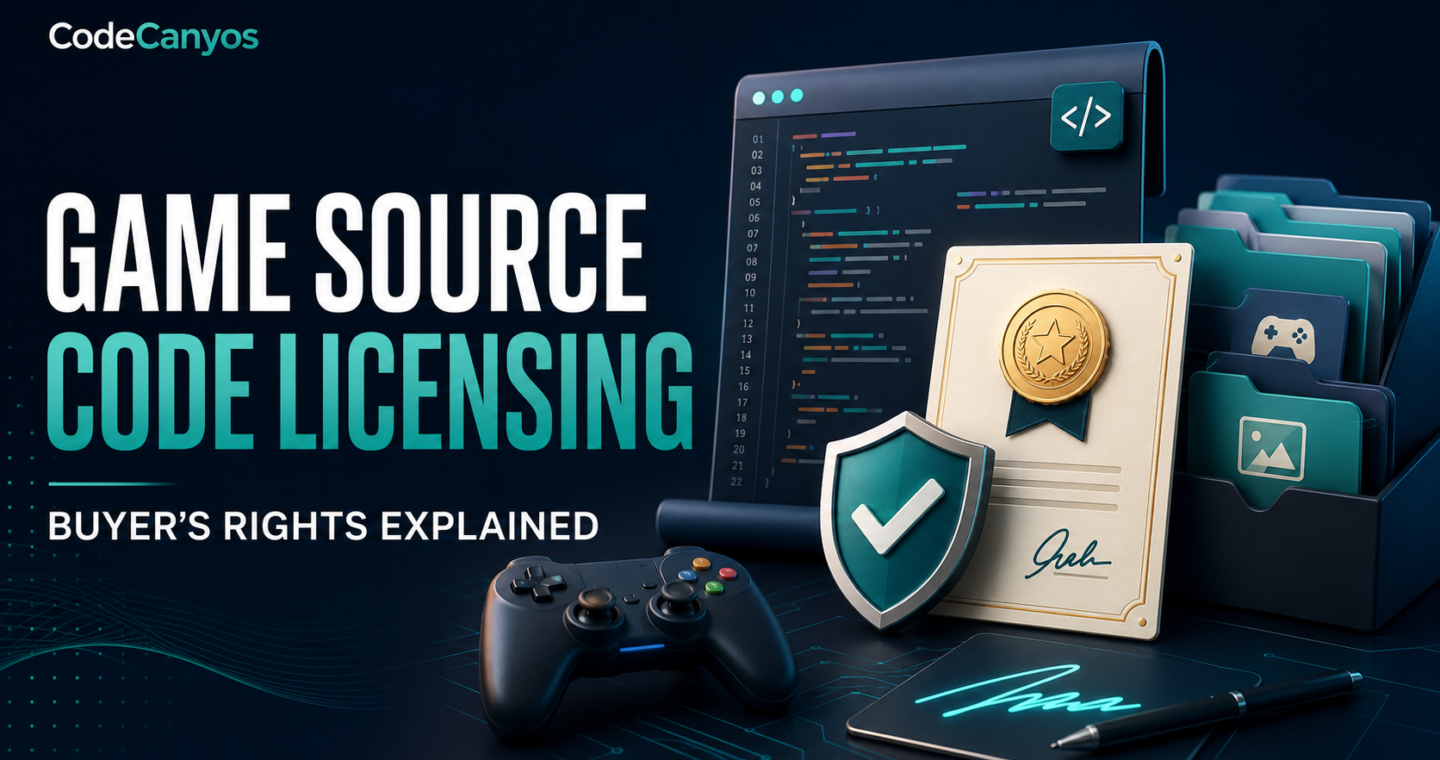
A game source code license explains what you may do with the files you receive. It is not the same as copyright ownership, and it may not cover every image, font, sound or third-party library inside the project. Reading the license before customization protects both the buyer and the people who created the underlying work.
This is a practical overview, not legal advice. Always read the specific terms attached to a product and ask a qualified professional when a business decision depends on interpretation.
License, ownership and access are different
Buying a download normally gives access to files under stated permissions. The original author or another rights holder may retain copyright. A license can permit modification and publication of an end product while prohibiting redistribution of the source package.
Possession of a ZIP file does not prove that the seller had authority to license it. Use reputable sources, retain purchase records and avoid files whose provenance is unclear.
What is an end product?
Many marketplace licenses distinguish the source item from an end product. A branded game published on a website or store may be an end product. A lightly renamed archive offered for download is usually still redistribution of the source.
Check whether one license covers one end product, one domain, one client or multiple projects. Do not assume that a low-cost license allows unlimited resales.
Personal, commercial and client use
Commercial use generally means the end product supports a business, earns revenue or is delivered for payment. Client work may be allowed when the final product is transferred to one client, but the client may need to follow the same restrictions.
Record which license belongs to which project and customer. If you reuse a template for another client, confirm whether another license is required.
Redistribution restrictions
Source-code licenses commonly restrict sharing, reselling, sublicensing or making the original files available to others. A public repository can be redistribution even when no price is charged. Contractors who need access should be covered by the terms and should not retain or reuse files beyond the project.
Protect downloads and repositories with appropriate access controls. Remove source archives from public production directories.
Third-party assets need separate review
A project may contain fonts, stock images, music, models, icons, plug-ins and SDKs from several sources. The main license may not override those terms. Some assets permit use only in the original demo or require attribution; others may not be transferable.
Create an asset register with file name, source, license, attribution and replacement status. Replace any item that cannot be verified.
Open-source components
Open source does not mean no conditions. Permissive licenses may require copyright notices. Copyleft licenses can impose source-sharing obligations in certain forms of distribution. Network, media and data packages may each use different terms.
Keep notices provided with dependencies and review obligations before combining code with proprietary systems.
GPL and game projects
The GNU General Public License grants important freedoms for covered code, including use, study, modification and redistribution under its conditions. It does not automatically make unrelated art, trademarks or hosted services part of the same license.
Identify exactly which files are GPL-covered and preserve required notices and source availability obligations when distributing modified covered code.
Store publishing is a separate requirement
Permission from a source-code license does not guarantee acceptance by Google Play, Apple or a web portal. Stores apply their own rules for repetitive content, privacy, data safety, advertising, payments and intellectual property.
Create original branding, test the product and complete policy declarations based on the final build.
Trademarks, characters and branding
A code license does not grant rights to imitate a famous game, character, company name or logo. Choose a distinct product identity and search for potential conflicts before investing in marketing.
Remove seller branding, support addresses and domains from the finished game unless permission explicitly says otherwise.
Questions to answer before buying
- Who owns or is authorized to distribute the source?
- How many end products, sites or clients are covered?
- May the product earn revenue?
- Can contractors access the files?
- Which assets or services have separate terms?
- What notices or attribution must remain?
- Are updates and support included, and for how long?
Combine these questions with the 15-point source-code buying checklist.
Records to keep
Save the invoice, license text and product page as they appeared at purchase. Keep dependency notices, asset receipts, emails clarifying permissions and the release version associated with each record.
A simple licensing folder is easier to maintain than reconstructing evidence during a store dispute or client handover.
Common licensing mistakes
- Assuming editable files include full copyright ownership.
- Publishing assets whose licenses were never checked.
- Using one-product terms for many client projects.
- Uploading the purchased source to a public repository.
- Ignoring store rules because the source license allows commercial use.
Final licensing checklist
Read the exact license, confirm seller authority, separate code rights from asset rights and document every third-party dependency. Define the end product before buying and verify whether the planned domains, stores, clients and revenue model are allowed.
Then evaluate the technical project using the HTML5, Unity or Android game source-code guide that matches your release.